
Copper mining has played an important role in the economic and industrial development of British Columbia for more than a century. The province’s complex geology contains substantial mineral resources, and the discovery of commercially valuable copper deposits encouraged investment in mines, transportation networks, processing facilities and new communities. From remote underground operations to increasingly large and technologically advanced projects, copper mining helped connect previously isolated areas with regional and international markets. The industry created employment, stimulated infrastructure development and contributed to the growth of engineering and mineral-processing expertise that became important parts of the provincial economy.
Historic operations such as Britannia mining provide a particularly useful perspective on this development. Located in challenging mountainous environments, early mines required far more than access to valuable ore. Companies needed transportation systems, power, processing facilities, skilled workers and communities capable of supporting long-term operations. Many of the structures and technologies associated with this period have disappeared, making preserved industrial sites especially valuable for understanding how the industry evolved.
Early Mineral Exploration and Copper Discoveries
Long before modern mining operations appeared, the mineral wealth of the region attracted the attention of explorers, prospectors and investors. During the nineteenth century, expanding geological knowledge and growing demand for industrial metals encouraged more systematic exploration. Copper became increasingly important as electrical systems, manufacturing and transportation infrastructure expanded around the world. Deposits that might previously have been considered too remote or difficult to develop became economically attractive when transportation and processing technologies improved.
The geography of British Columbia created both opportunities and obstacles. Mountain ranges contained valuable mineral deposits, but steep terrain, forests, rivers and long distances from established settlements made development expensive. A successful mine often required extensive infrastructure before significant production could begin. Roads, rail connections, docks or other transportation systems were needed to move workers, equipment and mineral products. As a result, the history of copper mining is also a history of engineering and infrastructure development.
The Growth of Industrial Copper Mining
By the late nineteenth and early twentieth centuries, mining was becoming increasingly industrialized. Small-scale prospecting could identify promising mineral deposits, but commercial production required capital, machinery and organized labour. Underground tunnels were expanded, mechanical drilling became more important and processing plants were constructed to separate valuable copper minerals from surrounding rock.
As production increased, mines became complex industrial systems. Ore extraction was only the first stage. Rock had to be transported, crushed, ground and concentrated before the resulting mineral product could be shipped for further processing. Power generation, water management and equipment maintenance were also essential. This industrial integration transformed mining from a relatively localized activity into a major economic sector connected with transportation, manufacturing and international commodity markets.
Britannia Mining and the Howe Sound Region
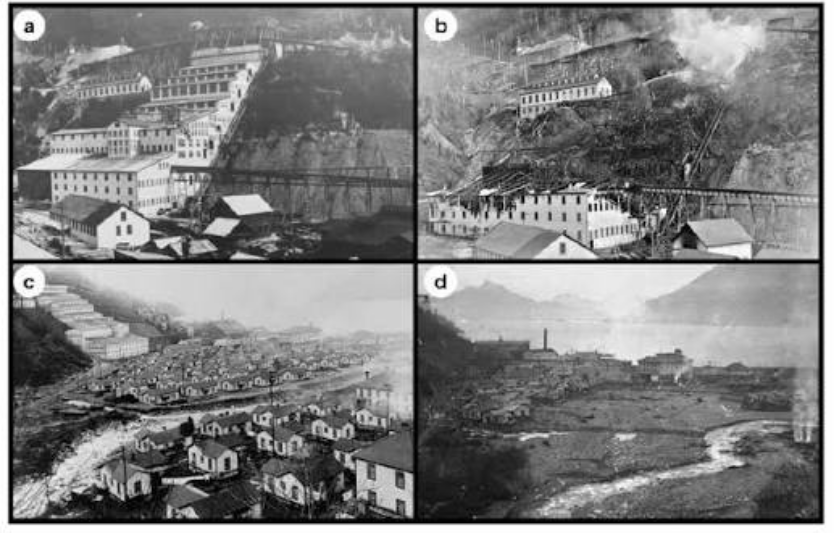
One of the most notable chapters in the province’s copper history developed along Howe Sound. Britannia mining grew around mineral deposits located in steep mountains near the coast, where geography created substantial engineering and logistical challenges. The operation eventually included extensive underground workings and large processing facilities, demonstrating how industrial technology could be adapted to a difficult natural environment.
The mine also encouraged the development of settlements for workers and their families. Housing and community services were necessary because the operation was relatively isolated from larger population centres. The resulting community became closely connected with the mine’s economic activity. Work schedules, transportation and everyday social life were strongly influenced by industrial production, illustrating how a single resource project could shape both the physical and social development of an area.
Copper Processing and Technological Development
The ability to process large quantities of ore efficiently was essential to the expansion of copper production. Extracted rock typically contained a mixture of valuable minerals and unwanted material, making concentration an important stage of the mining process. Crushing reduced the size of the ore, grinding prepared it for further treatment, and concentration techniques separated copper-bearing minerals from much of the surrounding rock.
Processing technology evolved as engineers searched for ways to increase recovery and handle greater quantities of material. Large concentrators became prominent features at important mining sites. Their machinery, internal layouts and transportation systems reflected the technical requirements of mineral processing. Preserved facilities interpreted today through institutions associated with the mining museum BC experience help modern visitors understand the enormous industrial systems that operated behind the simple phrase “copper mining.”
Mining Communities and Their Workers
The expansion of the industry created communities whose existence was closely connected to mineral production. Remote mines needed miners, mechanics, engineers, equipment operators, tradespeople and many other workers. Because travelling long distances to work was often impractical, settlements developed near major operations. These communities could include housing, schools, stores and recreational facilities, creating environments in which industrial and personal life were closely connected.
Working conditions varied considerably depending on the period and type of employment. Underground mining was physically demanding and involved occupational hazards that required increasingly sophisticated safety procedures. Technological improvements gradually changed how miners drilled, moved rock and communicated underground. Surface workers faced different challenges associated with heavy machinery and mineral processing. Preserved records, equipment and buildings now help historians reconstruct these experiences and explain the human dimension of the industry.
Transportation and Infrastructure
Transportation was one of the fundamental challenges facing historic mining operations. A valuable mineral deposit had limited commercial potential if equipment could not reach the site or processed material could not be transported economically to customers and smelters. Coastal locations could use marine transportation, while mines elsewhere depended on combinations of roads and railways. Improvements in regional infrastructure frequently made previously inaccessible deposits more practical to develop.
Mining projects could also stimulate infrastructure improvements beyond the boundaries of individual operations. Transportation routes, electrical systems and supporting services created for resource industries sometimes contributed to broader regional development. This relationship between extraction and infrastructure demonstrates why mining history cannot be separated from the economic geography of the province.
Changing Technology and Modern Mining
Mining technology changed substantially during the twentieth century. Mechanization increased productivity and reduced reliance on some forms of manual labour, while advances in geological exploration made it possible to identify and evaluate mineral deposits more accurately. Larger equipment enabled mines to move far greater quantities of rock, and improvements in mineral processing increased the efficiency of copper recovery.
The scale and organization of mining operations also changed. Modern projects rely on sophisticated geological modelling, automated systems, environmental monitoring and specialized engineering. These technologies differ significantly from those used at early industrial mines, yet many fundamental challenges remain familiar: locating economically viable ore, moving large volumes of material safely and processing minerals efficiently. Comparing modern operations with historic sites provides a useful perspective on more than a century of technological change.
Environmental Legacy of Historic Mines
The historical importance of copper mining must also be considered alongside its environmental effects. Many early operations were established before modern environmental standards and remediation practices existed. Waste rock, tailings and water passing through mineralized underground workings could create environmental problems that continued after production ended. These legacies eventually encouraged greater attention to mine closure, water treatment and long-term site management.
Environmental remediation has consequently become an important part of the story told at former industrial locations. Understanding these challenges provides a more complete interpretation of mining history by acknowledging both economic contributions and long-term consequences. The evolution of environmental management also demonstrates how public expectations and technical standards surrounding resource development have changed.
Preserving Mining Heritage
When historic mines close, much of their infrastructure can quickly disappear. Machinery may be sold or removed, buildings can deteriorate and former industrial landscapes may be redeveloped. Museums and heritage organizations therefore play an important role in preserving representative structures, equipment, documents and personal stories associated with the industry.
Institutions connected with the history of the BC Museum of Mining and other heritage initiatives have helped maintain public access to this industrial past. Preserved mining sites can show visitors the physical scale of machinery and processing facilities in ways that photographs and written descriptions cannot. They can also explain geology, engineering, labour history and environmental change within the landscape where mining actually occurred.
The educational role of a mining museum BC visitors can explore is particularly important because industrial heritage combines many different subjects. A single historic site can demonstrate geological processes, mechanical engineering, architecture, transportation and social history. It can also encourage discussion about how resource development has changed and what lessons can be learned from earlier generations of mining.
The Continuing Importance of Copper
Copper remains an important industrial material because of its electrical and thermal conductivity, durability and versatility. It is widely used in electrical infrastructure, buildings, transportation systems, electronics and numerous manufactured products. Modern electrification and energy technologies have further reinforced the importance of reliable copper supplies, connecting the long history of mining with contemporary industrial development.
This continuing demand makes historic mining sites especially relevant. Britannia mining represents an earlier stage in an industry that continues to evolve as technologies, environmental expectations and economic conditions change. Looking at historic operations alongside modern mining helps demonstrate both continuity and transformation within the resource sector.
Understanding the Legacy of Copper Mining
The history of copper mining is ultimately about more than mineral production. Mines influenced transportation, settlement patterns, employment, engineering and regional economies while creating communities whose identities were often closely connected to industrial work. They also left environmental and physical legacies that continue to require interpretation and management long after extraction has ended.
Preservation initiatives such as those associated with the BC Museum of Mining ensure that important parts of this story remain accessible. Historic buildings, underground spaces, machinery and personal accounts allow new generations to examine how the industry operated and how it changed over time. Through museums, preserved landscapes and historical research, the legacy of copper mining continues to provide valuable insight into the industrial development of British Columbia and the complex relationship between natural resources, technology, communities and the environment.