
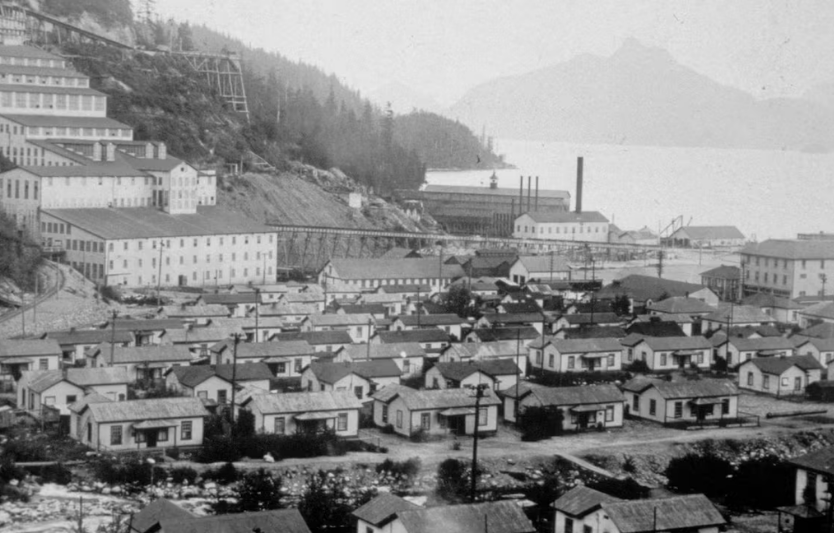
Britannia Beach is a small coastal community with a history closely connected to mining, industry and the dramatic landscape surrounding Howe Sound. What appears today as a quiet settlement developed because of one of the most significant mining operations in British Columbia. For decades, workers and their families lived here while supporting the extraction and processing of copper ore from the nearby mountains. The story of Britannia Beach is therefore not simply about industrial production. It is also about the people who created homes, services and social networks in a relatively isolated location where everyday life was strongly influenced by the mine.
Understanding the history of Britannia means looking at the relationship between natural resources, industrial development and community life. The steep mountains surrounding Howe Sound provided valuable mineral deposits but also created serious logistical challenges. Transportation was difficult, suitable building land was limited, and much of the infrastructure required for a permanent settlement had to be developed specifically for the mining operation. These conditions gave the community a distinctive character that continued to evolve throughout the twentieth century.
The Origins of the Mining Settlement
The development of Britannia Beach began with mineral exploration in the mountains above Howe Sound near the end of the nineteenth century. Copper deposits attracted growing commercial interest, but turning those deposits into a productive mining operation required substantial investment. The location was remote and mountainous, making conventional transportation and construction difficult. As mining activity expanded, infrastructure was needed not only for extracting and processing ore but also for accommodating the people who worked at the site.
A permanent community gradually developed alongside the industrial facilities. Workers required housing, food, transportation and essential services, while families needed places where they could establish relatively stable lives. This combination of industry and settlement became one of the defining characteristics of Britannia Beach BC. Unlike communities that developed primarily around agriculture, trade or transportation, this settlement was closely tied to a single large industrial operation and the economic opportunities it created.
A Community Built Around Copper Mining
Mining determined much of the rhythm of everyday life. Workers performed a wide range of jobs underground and in surface facilities, including mining, maintenance, transportation, ore processing and mechanical work. Technical specialists and engineers were also essential to maintaining the complex systems required to operate a large mine in difficult terrain. The workforce created demand for housing and community services, transforming the area from an industrial site into a functioning settlement.
For families living in Britannia Beach, the mine was more than an employer. It influenced schedules, transportation, social relationships and the physical organization of the community. Industrial facilities occupied prominent positions within the landscape, while residential and service areas developed around the needs of workers. This close connection between workplace and home is an important part of the history of Britannia because it illustrates how resource industries could shape entire communities rather than simply provide individual jobs.
Life in an Isolated Coastal Community
The geography of Howe Sound had a major influence on community life. Mountains rise sharply from the coastline, leaving limited space for construction and making overland travel historically difficult. Water transportation therefore played an important role in connecting residents with other settlements and larger urban centres. Before modern road access improved mobility, the relative isolation of Britannia Beach BC meant that residents depended heavily on local facilities and on one another.
Isolation encouraged the development of a strong community environment. Schools, recreational activities, shops and other services helped make everyday life possible for workers and their families. Social events provided opportunities for residents to meet outside the workplace, while organized activities helped create a sense of identity within the settlement. Although living conditions changed over the decades, the relationship between industrial employment and community life remained a central feature of the area.
Working in the Mining Industry
Employment at the mine could be physically demanding and potentially dangerous. Underground miners worked in environments very different from modern workplaces, using the equipment and safety practices available at the time. Other employees operated machinery, maintained infrastructure, transported materials and worked in the large processing facilities that transformed extracted rock into concentrated mineral products. Each part of the operation depended on coordination between different groups of skilled workers.
The scale of the industrial system also created opportunities for technological development. Mining methods, mechanical equipment and mineral-processing techniques evolved over time, requiring workers to adapt to new procedures and machinery. These changes form an important part of the history of Britannia, showing how the community developed alongside advances in industrial technology. Generations of employees gained specialized knowledge that supported the operation and contributed to the broader mining industry.
The Role of the Concentrator
One of the most recognizable structures associated with the community is the large concentrator known as Mill No. 3. Constructed on the steep mountainside, the building became a dominant feature of the industrial landscape. Its unusual vertical design was closely connected to the terrain and to the process used for handling and concentrating ore. Material could move through different stages of processing as it travelled through the facility, making effective use of the natural slope.
For residents, structures such as the concentrator were part of the everyday environment. They represented employment and economic activity but also demonstrated the enormous scale of the mining operation that sustained the settlement. Today, the surviving industrial architecture provides an important physical connection to the community’s past and helps visitors understand why Britannia Beach developed in this particular location.
Challenges of Living Beside a Major Industrial Site
Life in a mining community brought opportunities, but it also involved significant challenges. Industrial work carried occupational risks, while the coastal environment could produce difficult weather conditions. The steep terrain increased the complexity of construction and transportation, and the community remained vulnerable to disruptions that could affect both industrial operations and daily life.
Environmental issues also became an important part of the area’s long-term story. Historical mining practices were developed under different environmental standards from those applied today. As understanding of industrial pollution increased, greater attention was given to the effects of former mining operations on surrounding land and water. This environmental dimension has become an important element in modern interpretations of the history of Britannia, adding another perspective to the community’s industrial achievements.
The End of Mining and a Changing Community
The mining operation that had supported the community for decades eventually faced economic and operational pressures. Changing mineral markets, production costs and the challenges of maintaining an extensive industrial complex influenced its future. When mining ceased in 1974, the closure represented a major turning point for the settlement. A community whose development had been closely connected to a single industry suddenly had to adapt to a very different economic reality.
The transition was significant because the mine had shaped employment, housing and local identity for generations. Without active mining, the industrial structures and surrounding community needed new purposes. Some elements of the former operation disappeared or changed, while others were preserved because of their historical importance. Britannia Beach BC gradually moved away from its identity as an active company-centred mining settlement and entered a new stage of development.
From Industrial Settlement to Heritage Community
The preservation of important mining structures helped create a new relationship between Britannia Beach and its industrial past. Instead of viewing old buildings solely as remnants of a closed operation, heritage initiatives recognized their educational and cultural value. Surviving industrial spaces could demonstrate how mining technology worked while also providing a setting for telling the stories of the people who lived and worked in the community.
This transformation has allowed the area’s history to remain visible. Former industrial infrastructure provides evidence of the scale of copper production, while historical interpretation places that infrastructure within the broader context of workers, families and community development. The result is a more complete picture in which machinery and architecture are connected with everyday human experiences.
Why the History of Britannia Beach Matters
The story of Britannia Beach demonstrates how natural resources can influence the development of communities for generations. Copper deposits brought investment, workers and industrial technology to a geographically challenging location. In response, residents created a community with its own institutions, relationships and identity. Even after mining ended, the physical and cultural legacy of that period continued to shape the area.
Today, exploring the history of Britannia offers insight into several important themes in Canadian industrial development, including resource extraction, labour, engineering, environmental responsibility and heritage preservation. Britannia Beach remains a valuable example of how a community can evolve after the industry responsible for its original growth has disappeared. Its surviving landscape connects the modern settlement with the generations of workers and families who built their lives around one of British Columbia’s most distinctive mining operations.